Your Firm Probably Doesn’t Have an AI Problem
Our takeaways from AI-Ready AECO: A 90-Day Revit + Forma Data Scorecard at Autodesk University 2026
The premise showed up on the third slide and did not soften over the next hour:
Your firm probably does not have an AI problem. It has a data trust problem.
The argument behind it is uncomfortable because it is familiar. Firms are buying AI, automation, and dashboards faster than they are settling the standards those tools read from. Automation does not correct inconsistency. It repeats inconsistency faster and at greater scale. If your teams disagree about naming, status, ownership, parameters, or where the current information lives, an AI system inherits every bit of that uncertainty – at machine speed.
The session opened with four conditions and asked how many described your firm:
Standards that technically exist and are documented, but are not applied the same way on every project
A template, content library, folder structure, or coordination process with no clear owner
A dashboard or issue log that someone has to explain before anyone will act on it
A process being scripted or automated that was never agreed on in the first place
Most firms we work in have at least three of the four. That is not an unusual problem. That is what the industry looks like right now.
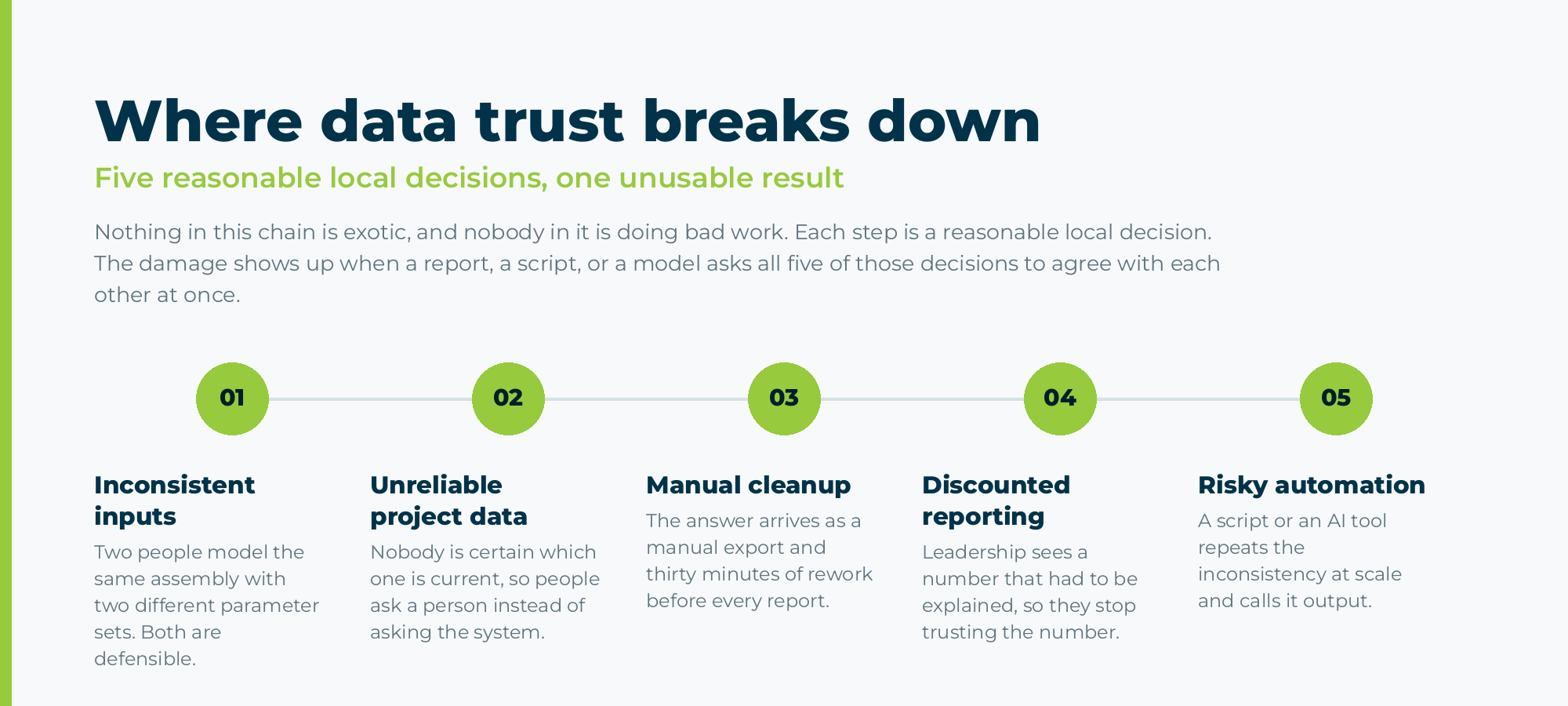
Where data trust breaks down: five reasonable local decisions, one unusable result.
Two people model the same assembly with two different parameter sets, and both are defensible. Nobody is certain which one is current, so people ask a person instead of asking the system. That question gets answered by a manual export and thirty minutes of cleanup. Leadership sees a number that had to be explained, so they stop trusting the number. And that is the step where somebody says the word AI.
Nothing in that chain is exotic, and nobody in it is doing bad work. Each step is a reasonable local decision. The damage shows up when a report, a script, or a model asks all five of those decisions to agree with each other at once.
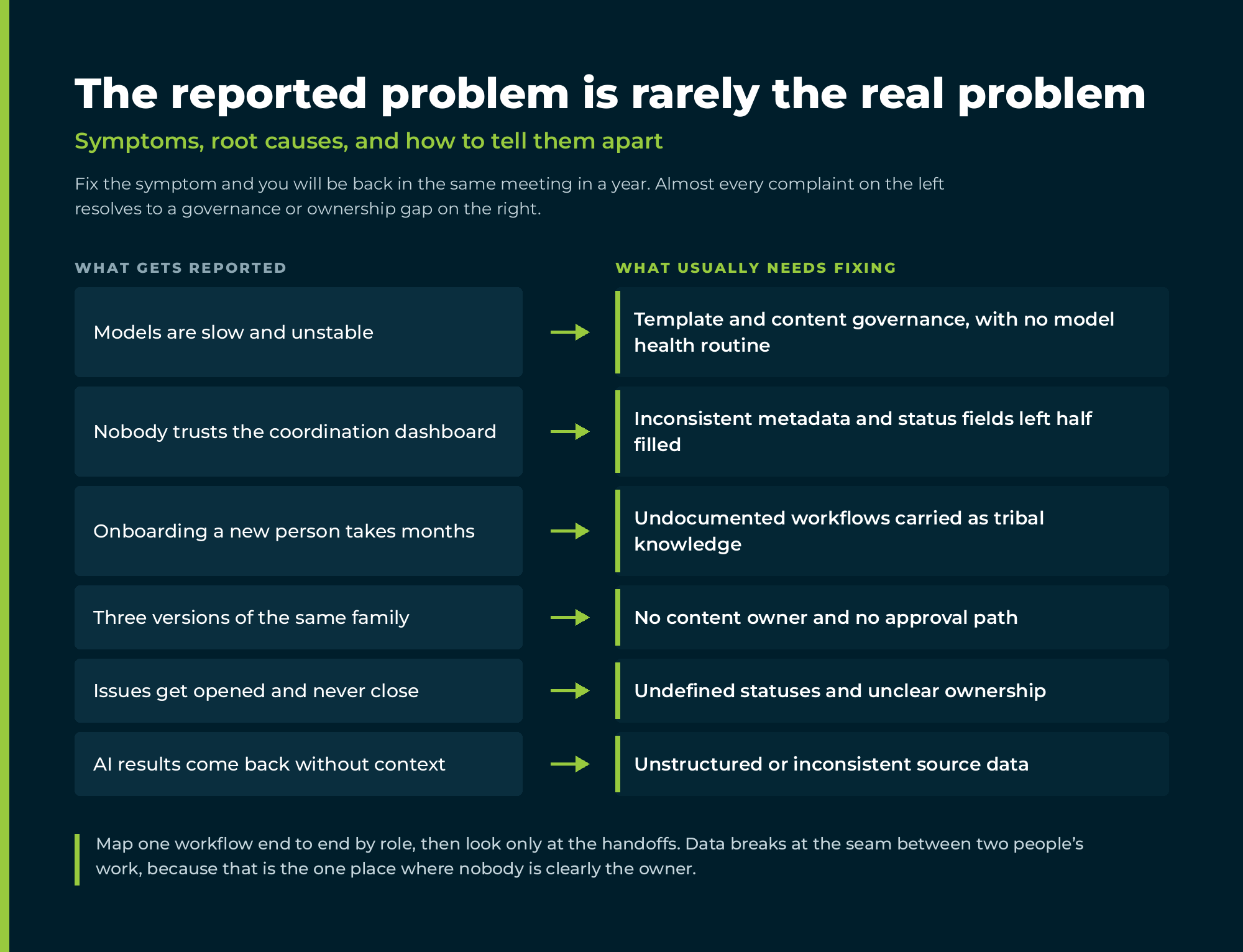
Symptoms on the left, root causes on the right.
This was the slide we would hand to leadership if we could only hand them one. Slow, unstable models get reported as a hardware or a Revit problem, and they are almost always a template and content governance problem. Onboarding that takes months gets reported as a training problem, and it is usually an undocumented-workflow problem. Fix the symptom and you will be back in the same meeting in a year.
The fastest way to get from the left column to the right one costs nothing. Take one workflow – project startup, a coordination cycle, a deliverable package – and map it end to end by role. Then look only at the handoffs. That is where data breaks, every time. Not in the middle of somebody’s work, at the seam between two people’s work, because a handoff is the one place where nobody is clearly the owner. Four people, a whiteboard, ninety minutes.
Seven categories, one honest scale
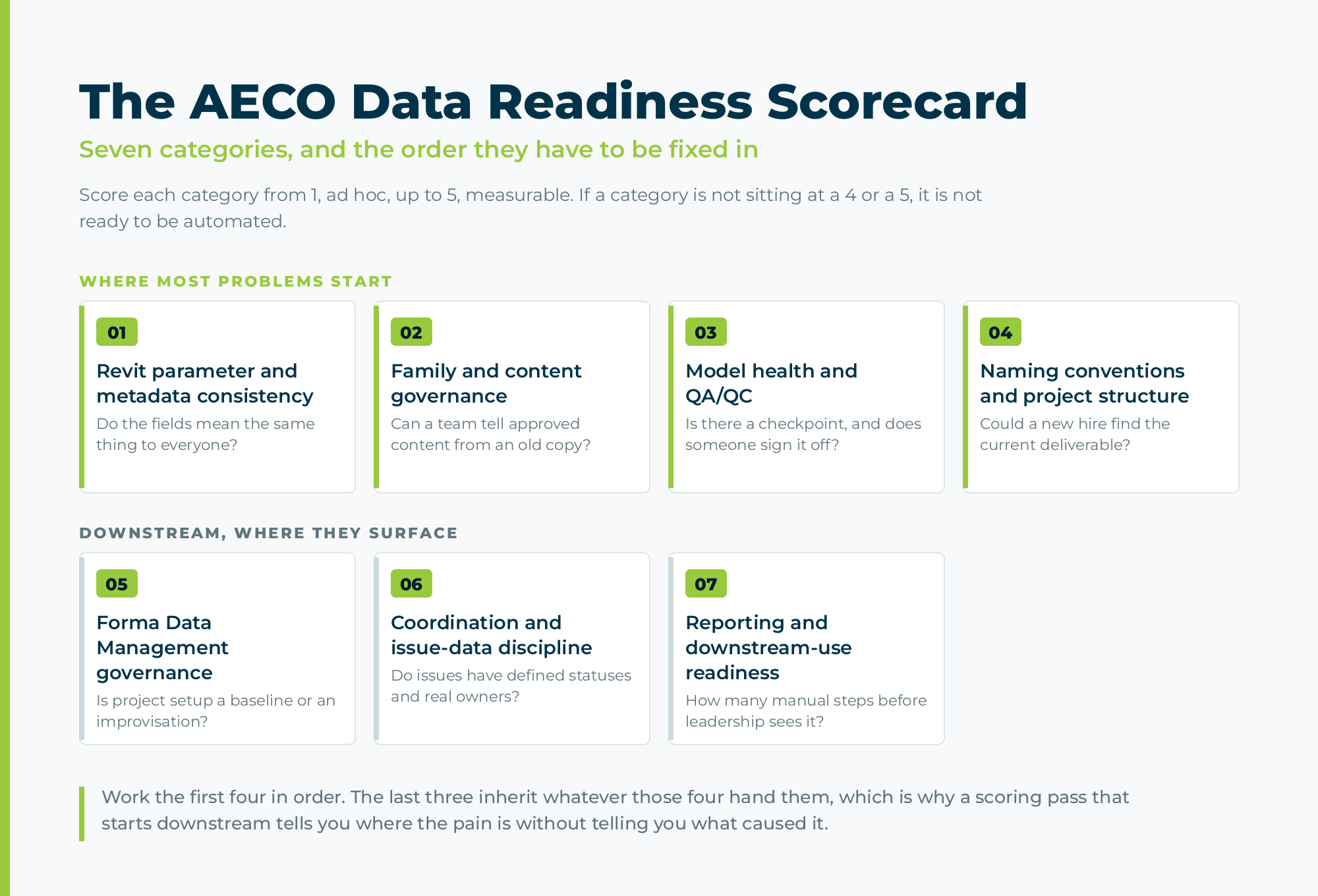
The seven categories of the AECO Data Readiness Scorecard.
The teaching artifact of the session is a scorecard with seven categories:
Revit parameter and metadata consistency
Family and content governance
Model health and QA/QC
Naming conventions and project structure
Forma Data Management governance
Coordination and issue-data discipline
Reporting and downstream-use readiness
Each is scored 1 to 5, from ad hoc up to measurable.
Level 1
The process depends on individual habits. Two projects run by two people look nothing alike. Nobody is wrong because nothing was agreed upon.
Ad Hoc
Level 2
Standards exist in places, but they vary by project, team, or whoever set the project up. Compliance is accidental.
Partially Defined
Level 3
Expectations are written down. Adoption is inconsistent and nobody is checking. This is where most firms actually sit.
Documented
Level 4
Ownership, checkpoints, and expectations are established. Someone is accountable and milestones are enforced. Exceptions get documented, not hidden.
Governed
Level 5
The process is repeatable and auditable. The output is reliable enough for reporting and automation. This is the bar AI actually requires.
Measurable
Level 3 is the trap. A written standard that nobody checks feels like progress and produces none, and most firms sit there while believing they are a level higher. Level 5 is the bar automation actually requires: repeatable, auditable, and usable without cleanup. If a category is not at a 4 or 5, it is not ready to be automated. That is not a criticism of anyone’s work. It is a sequencing decision.
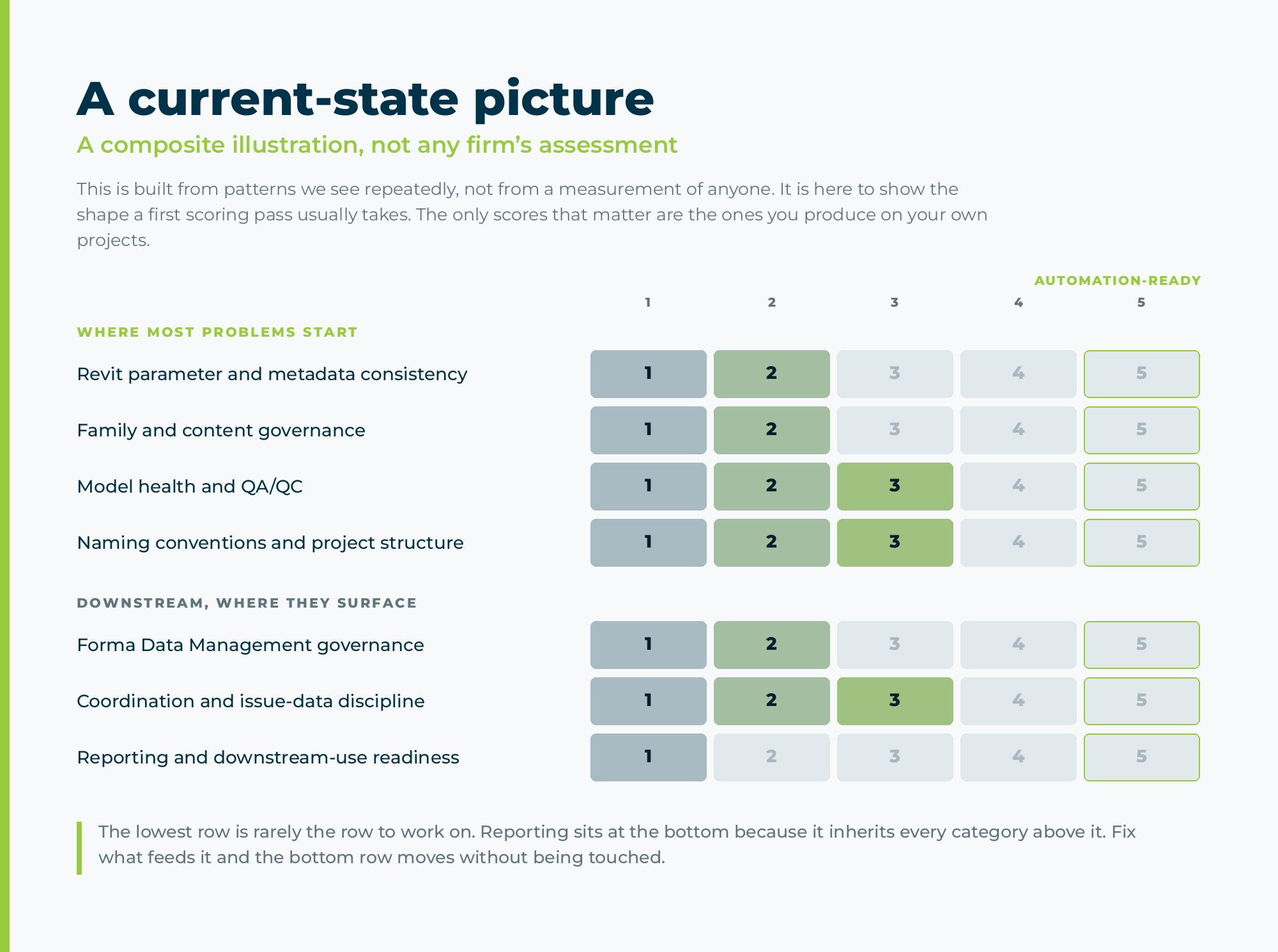
A composite heat map. Not a target, and not any single firm’s assessment.
There is a pattern in the scores worth pointing out. Reporting almost always lands lowest, because reporting sits downstream of everything above it. Reporting does not have its own problem. It has six other categories’ problems. You cannot fix the bottom row by working on the bottom row.
The part that is genuinely hard to do alone
The session was direct about the limit of self-scoring, and it is the reason we are writing this.
A 3 only means something if you have seen what a 4 looks like somewhere else. Your firm cannot see outside itself. You will score yourself against your own memory, and your own memory is shaped by your own habits.
There is a second version of the same problem inside the assessment itself. If you are the BIM manager asking production staff which of your standards waste their time, you will get a polite answer. Not because anyone is lying – because you wrote the standard. The recommendation from the session was to get someone with no stake in the answer to ask the question.
That is exactly the job an AECO Data Readiness Scorecard does, and four of those seven categories are already what it examines: parameter and metadata consistency, family and content governance, model health, and naming and project structure. We run it for Architecture, MEP, and Structure, by discipline, because a structural team’s failure points are not an architectural team’s failure points.
What comes back is not a report card. It is a current position, the gaps that matter most, and a sequence. Which fits the session’s own framing of days 1 through 30: the first month is not for rebuilding everything. It is for deciding what is worth rebuilding.
Then the standard has to survive a busy month
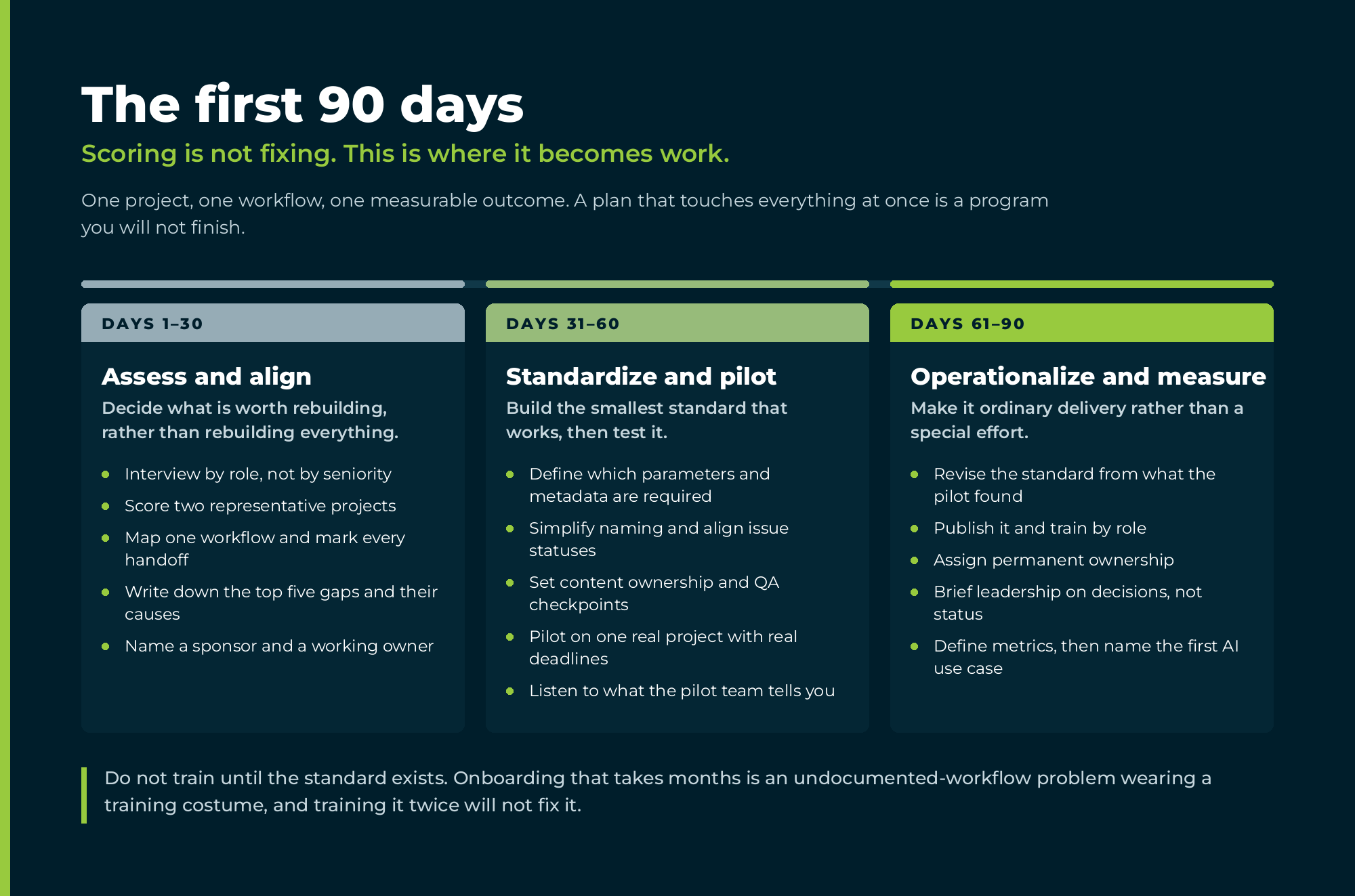
The 30/60/90 sequence. Scoring is not fixing.
Days 31 through 60 are for defining a minimum standard and piloting it on one real project with real deadlines. A pilot on a quiet project proves nothing.
Days 61 through 90 are where it becomes normal delivery: revise from what the pilot taught you, publish it, train by role, assign permanent ownership, and brief leadership with the decisions you need from them rather than a status update.
Note the order. Training is not the fix for a standard that does not exist yet – as the symptom list makes clear, onboarding takes months is usually an undocumented-workflow problem wearing a training costume. Training is what makes a defined standard hold once you have one.
That is the slot ATG Revit Boot Camp fills. Instructor-led, practice-driven, and built by discipline for Architecture, MEP, and Structure, so a team learns the workflow it will actually be held to instead of a generic tour of the software.
What we are not going to tell you
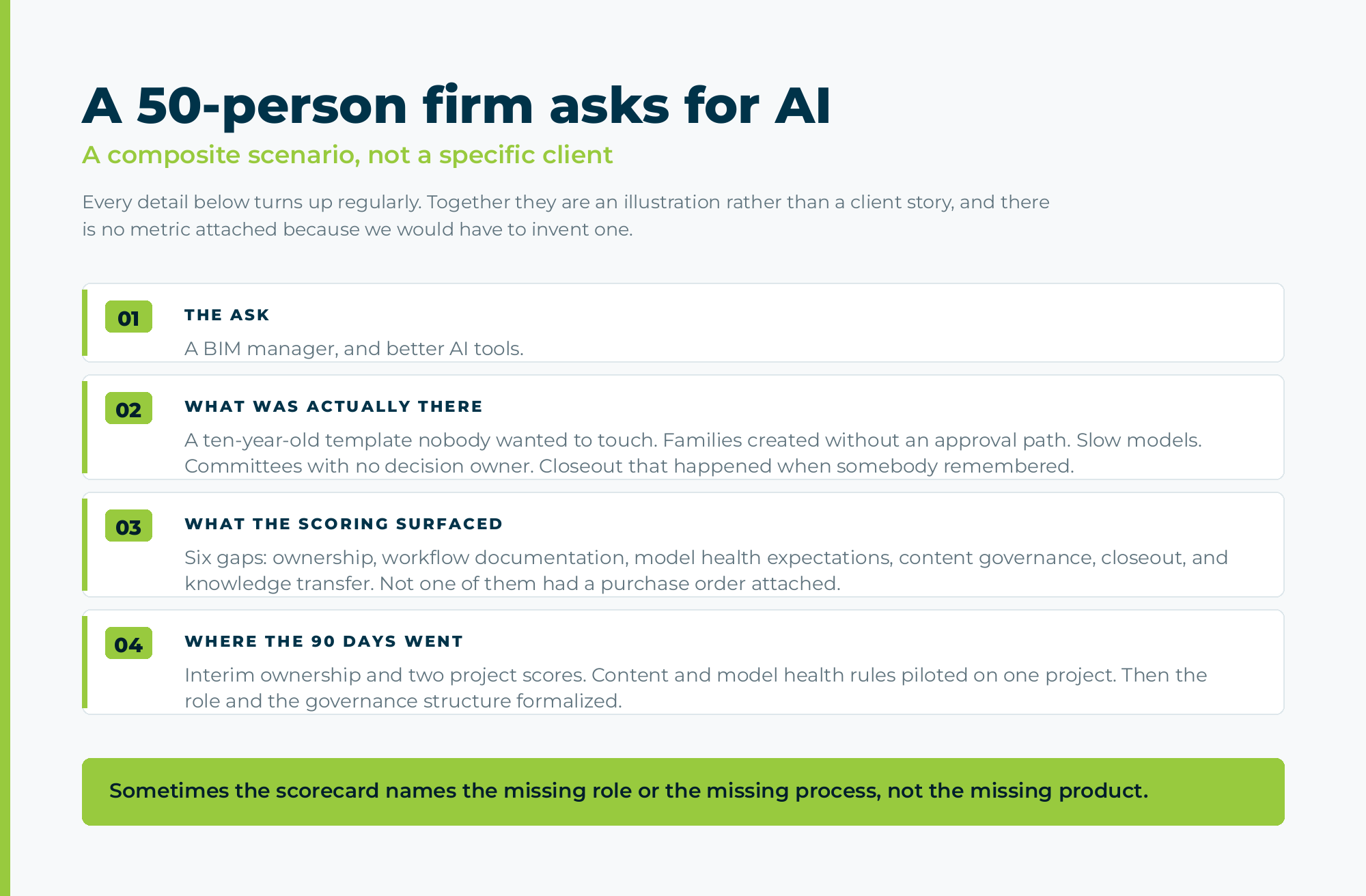
The session’s one case study, labeled on the slide as a composite.
The case study is a 50-person firm that came to the table asking for a BIM manager and better AI tools. What was actually there: a ten-year-old template nobody wanted to touch, families created without an approval path, slow models, committees with no decision owner, and closeout that happened when somebody remembered. Six gaps surfaced, and not one of them had a purchase order attached.
It is also labeled on the slide as a composite, with no firm name, no metric, and no result, because inventing those would have been the easy version. We are holding to the same policy here. If we ever put a number in front of you, it will be one we measured on your projects.
Where to start on Monday
Identify one business outcome that requires trusted data. Score the workflow that supports it. Fix the highest-impact gap before adding more technology.
One project, one workflow, one measurable outcome. That is a real 90 days. Everything else is a program you will not finish.
Score your own firm with the AECO Data-Readiness Scorecard
Before you look at new tools, access the scorecard below and spend 10 minutes evaluating a single active project with a teammate.
When you find out where your data breaks down, reach out to our team and learn about our discipline-specific Revit Assessment for Architecture, MEP, or Structure, and stay tuned for Revit Boot Camp next month.