How LiDAR Saves Buildings and Budget with Loads and Tolerances
Capture true geometry, verify tight tolerances, and spot costly deviations early to ensure safety and compliance with LiDAR technology.
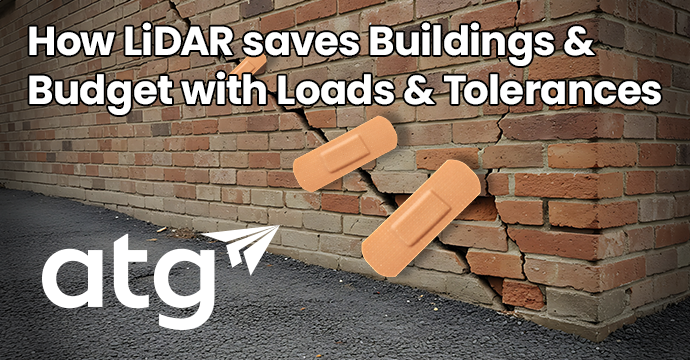
Have you ever considered the impact time plays on a building’s structural integrity? Beams that sag slightly, walls that are a fraction out of place, bolts that are misaligned — these seemingly small issues have the potential to be catastrophic to both safety and budget.
Traditional methods often rely on limited measurements, leaving room for error that can compromise a building’s integrity and safety. This is where LiDAR scanning steps in.
By capturing billions of precise data points, LiDAR is revolutionizing the way we access, manage, and verify structural data in the built environment. It’s a powerful tool that offers insight into a structure’s loads (the stress it bears) and tolerances (acceptable deviations from its design), helping keep projects safe, compliant, and on budget.
Capture True Geometry
Structures will settle, bend, or shift over time due to soil integrity, material deterioration, or environmental factors. These movements are usually invisible to the human eye, but even a small shift can have a big impact on a structure’s safety.
LiDAR scanners capture detailed shapes of structures, including walls, beams, columns, and floors visible to the scanner, giving you a true sense of how the building and its parts are sitting in the real world.
Engineers can use this data to model real-world conditions and then compare it against the original drawings or model. The ability to see these imperfections makes it easier to calculate structural loads based on how much the material has deviated.
Real-World Scenario
A beam that was supposed to be perfectly horizontal but now sags 1 inch can dramatically change stress calculations and potentially indicate that a structure is compromised under expected loads.
Spot Deviations Early
In construction, a small mistake in one phase can lead to major problems later, often resulting in costly rework or structural issues. When it comes to quality assurance and control, LiDAR plays a crucial role in ensuring accuracy during the build process.
By routinely scanning installed elements such as steel frames, bolt patterns in concrete, or precast panels, teams can quickly verify placement and spot out-of-place walls, misaligned bolts, and tolerances outside acceptable limits for steel beams.
Real-World Scenario
A floor slab poured with an unexpected slope or items installed incorrectly can affect different tolerances. Elements outside their tolerances slowly succumb to the extra stress, causing structural issues in the future.
Verify Compliance with Tolerances
Construction specifications often call for very tight tolerances, or the maximum allowed deviation from the exact design dimension. These might be as strict as ±1/4″ for walls or ±1/8″ for machine foundations where precision is critical.
While traditional measurement is slow and prone to error, LiDAR changes the game with direct and rapid measurements to help determine whether as-built elements are within compliance.
Advanced software can process the point cloud data and automatically generate compliance reports, offering an objective record that the work meets the design criteria.
Real-World Scenario
Quickly validate that steel columns are within the allowed tolerances before proceeding to install roof trusses or beams.
Conclusion
LiDAR is more than just a measurement tool — it’s a critical quality assurance tool that provides detailed, accurate data on geometry, loads, and tolerances, empowering engineers to make informed decisions, catch errors, and ultimately deliver structures that are safer, compliant, and built as intended.